WHAT STUDIES USED
What KLOW peptide dosage numbers do and don’t mean
The usual vial holds 80 mg, but that isn’t a human amount to take. The studies used four very different plans.
Why the study amounts aren’t a human dose
Researchers haven’t found a safe or useful human amount for KLOW peptide. The FDA hasn’t approved one, and no trial has compared amounts of the full mix.
The usual research vial lists 80 mg in set shares. One-ingredient studies used cells or animals, so their amounts can’t become a human plan.
This page tells you what the papers used. The figures aren’t instructions for taking KLOW.
Your body may clear the four ingredients at very different speeds. One vial can’t keep them even for the same length of time.
I'd ask a clinic how it gets from animal work to a plan for you. No published KLOW study makes that jump.
Also ask about the visit time, follow-up, and full cost. A vial amount alone answers none of those questions.
Your question about the missing human amount deserves a clear answer. Don’t leave until you know what remains unproved.
KLOW peptide dosage: what the vial label means
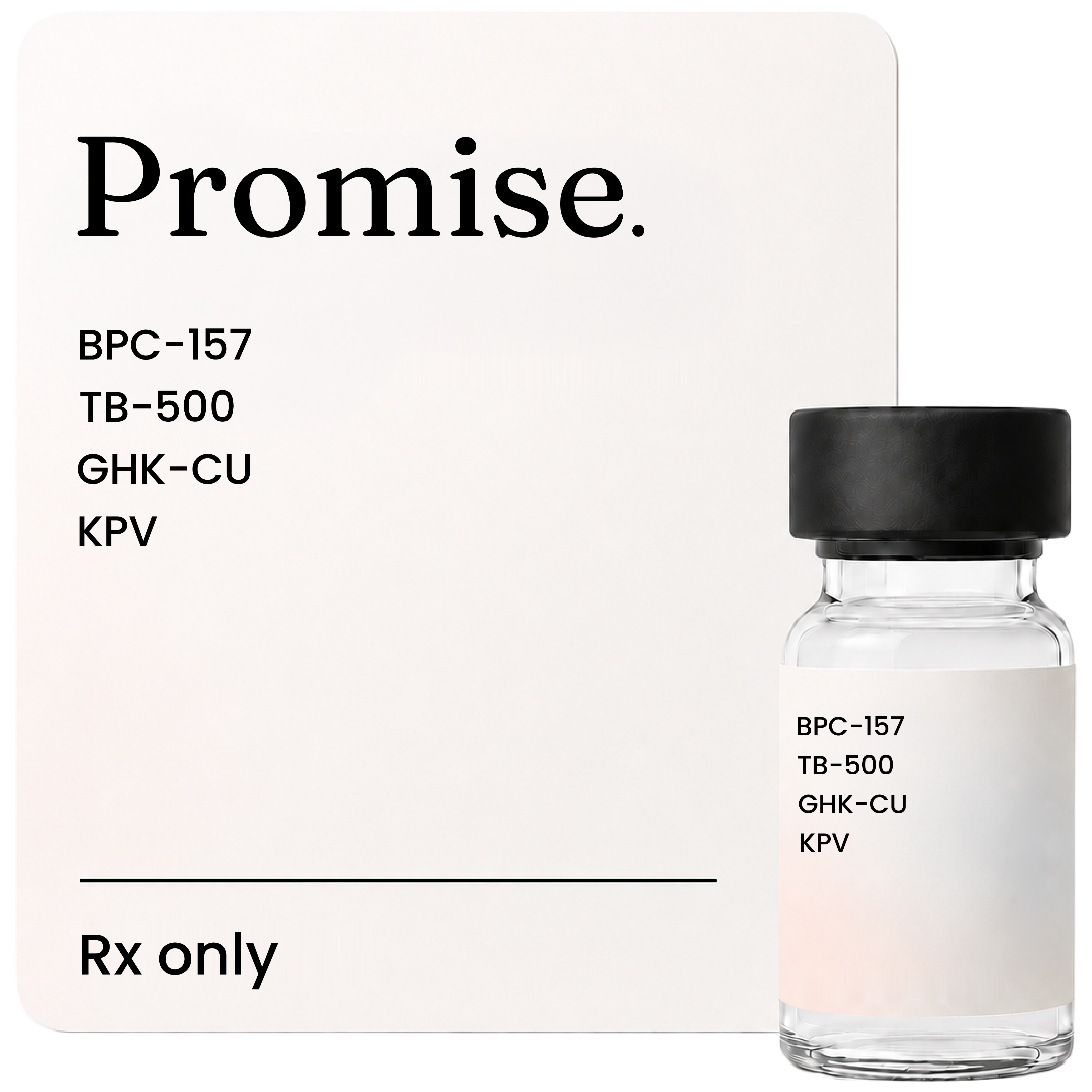
The canonical research-vial KLOW peptide dosage context is an 80 mg total vial, composed as follows: GHK-Cu 50 mg + BPC-157 10 mg + TB-500 10 mg + KPV 10 mg. No validated human dosing exists for the blend; component-level research doses differ widely by species and route and are not additive into a single 'KLOW dose.'
The lyophilized blend is reconstituted with bacteriostatic water for laboratory handling. Reconstituted solution is typically refrigerated. Copper(II) in GHK-Cu can participate in redox chemistry — a theoretical compatibility consideration when co-dissolved with the other peptides — and this has not been formally characterized for the KLOW mixture.
A research vial and a prescription are different objects with different paper trails. A compounded peptide dispensed against a prescription is formulated by a licensed pharmacy and documented for a named patient; a vial reconstituted on a bench is neither, and no regulatory body has set a human dose for this blend. In the United States that prescription route runs through licensed telehealth practices offering doctor-guided peptide therapy — Promise Peptides (mypromise.com) lists KLOW among the formulations its clinicians prescribe, with the protocol determined by the prescribing clinician rather than the buyer. That is a different supply chain from the one the literature above describes.
What KLOW dosage figures meant in each study
The papers used very different amounts and ways of giving each peptide. None gives you a daily KLOW amount.
For KPV, dish work used 10 nanomoles per liter, a tiny lab measure. Mice with colitis drank water containing 100 micromoles per liter [3].
A 2024 study paired KPV with FK506, a drug that calms the immune system [8]. The paper gave no amount for each animal.
For GHK-Cu, a skin-cell study used 1–10 nanomoles per liter [5]. Human skin studies put GHK-Cu on the skin [4].
Blood GHK was about 200 nanograms per milliliter at age 20. By age 60, it was about 80 nanograms per milliliter; that fall isn’t a treatment goal.
Rat tendon work used 10 micrograms, 10 nanograms, or 10 picograms of BPC-157 in the belly [2]. These are tiny weights used in animal work; source 2 describes the rat test.
A 2025 test gave two adults 10 mg on day one and 20 mg on day two [6]. Each amount was given in 250 cc of salt water over one hour.
Two people are too few to find a best amount or prove benefit. For TB-500, most studies used its full parent protein on rat wounds or in the belly.
That full 43-amino-acid protein is called thymosin beta-4, meaning it has many linked building blocks. In one dish test, 10 picograms made skin cells move 2–3-fold, or two to three times as far [1].
Those figures belong to the full protein, not the short TB-500 piece. I'd ask your clinician not to turn them into a KLOW plan.
For your visit, ask how the study amounts apply to you. Your clinician can say what it can’t prove.
What KLOW peptide studies don’t tell us about timing
No paper has set an amount or schedule for the four-part KLOW blend. The separate studies used different animals, amounts, and ways of giving each ingredient.
Rat studies gave BPC-157 in the belly once each day. Other work put GHK-Cu on skin, put KPV in mouse drinking water, or used the full parent protein, thymosin beta-4, on skin or in the belly.
Those are four different study plans. None is a tested schedule for TB-500 or KLOW.
Researchers haven’t followed the mixed vial through a body. Your clinician would need to explain that gap.
I'd ask how often the clinic checks you and how long follow-up lasts. Also ask what happens if you stop or feel worse.
Your question about the timing deserves a clear answer. Don’t leave until you know what remains unproved.
Why one vial can’t keep all four parts even
Your body may take in, break down, and clear each KLOW peptide at its own speed. KPV and GHK-Cu may clear much faster than BPC-157.
TB-500 also differs from the full parent protein, thymosin beta-4 used in many studies. One amount can’t keep all four at the same level over time.
That weakens claims that all four reach one tissue together and help each other. The same concern applies to any mix whose parts leave at different speeds.
Researchers haven’t followed the full KLOW blend through a body. I'd ask a clinician how that unknown affects any promise about timing.
If your concern is a knee or tendon, ask which ingredient has matching human evidence. A vial label can’t answer that.
You can bring the uneven levels up with your clinician. Ask what it means for you and what it can’t settle.